


















Thanks for your rating and feedback!
You have already rated.

Operating System notes: Processes, CPU Scheduling, Deadlocks & Memory
Operating System is a free Computer Science and Software Engineering handbook covering important course topics, detailed notes, diagrams, equations, formulas and study materials. Download this digital book and reference guide for Diploma, BE, BTech, BCA, BSc, MCA and related degree courses.
Explore 125 topics across 5 chapters on operating systems, processes, threads, CPU scheduling, synchronization, deadlocks, memory management, virtual memory, file systems and disk scheduling. Useful for university exams, GATE revision, viva, interviews, assignments and quick revision.
RELATED ENGINEERING BRANCHES
Computer Science Engineering (CSE), Information Technology (IT), Software Engineering, Computer Engineering, Computer Applications and related computing courses.
94 DISTINCT LISTED TOPICS FROM 125
OPERATING SYSTEM FUNDAMENTALS
1. Overview of Computer Operating Systems
2. Computer System Organization
3. Operating System Structure
4. Distributed Systems
5. Operating System Services
6. System Calls
7. System Programs
8. Operating System Generation
9. Operating System Interfaces
PROCESSES, THREADS & CPU SCHEDULING
10. Process Management
11. Process Control Block (PCB)
12. Schedulers
13. Context Switching
14. Operations on Processes
15. Interprocess Communication (IPC)
16. Sockets
17. Remote Procedure Calls (RPC)
18. Remote Method Invocation (RMI)
19. Threads
20. Scheduling Criteria
21. Scheduling Algorithms
22. Multithreading Models
23. Thread Libraries
24. Threading Issues
25. CPU Scheduling
26. Multiprocessor Scheduling
27. Symmetric Multithreading
28. Thread Scheduling
29. Solaris Scheduling
30. Windows XP Scheduling
31. Linux Scheduling
32. Algorithm Evaluation
SYNCHRONIZATION & DEADLOCKS
33. Process Synchronization
34. Critical Section Problem
35. Synchronization Hardware
36. Semaphores
37. Classic Synchronization Problems
38. Monitors
39. Atomic Transactions
40. Deadlocks
41. Deadlock Characterization
42. Methods for Handling Deadlocks
43. Deadlock Prevention
44. Deadlock Avoidance
45. Banker's Algorithm
46. Deadlock Detection
47. Recovery from Deadlock
MEMORY MANAGEMENT & VIRTUAL MEMORY
48. Memory Management Strategies
49. Address Binding
50. Logical vs Physical Address Spaces
51. Dynamic Linking and Loading
52. Swapping
53. Contiguous Memory Allocation
54. Fragmentation
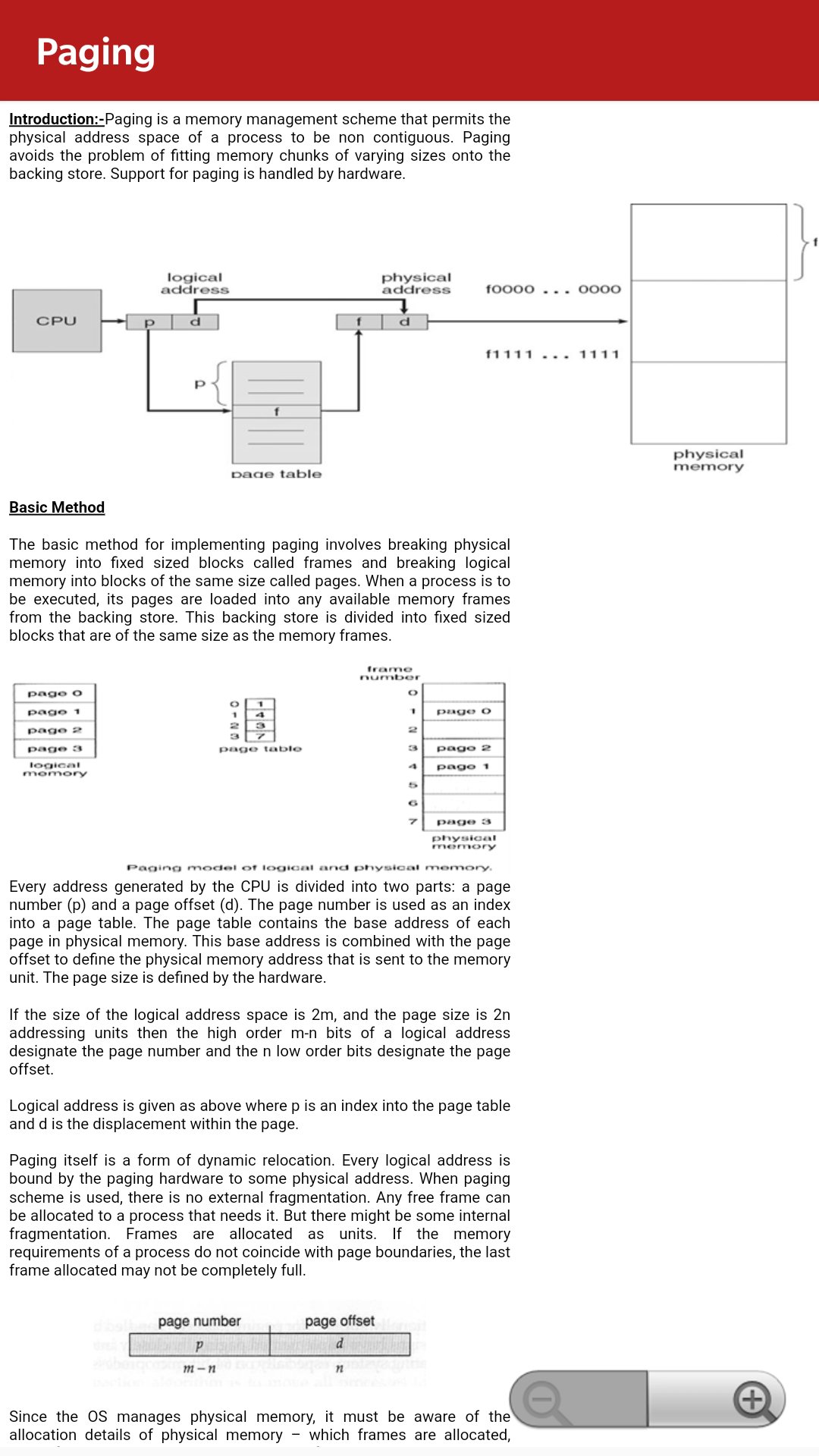
55. Paging
56. Hardware Support for Paging
57. Shared Pages
58. Segmentation
59. Virtual Memory
60. System Libraries
61. Demand Paging
62. Copy-on-Write
63. Page Replacement
64. FIFO Page Replacement
65. Optimal Page Replacement
66. LRU Page Replacement
67. Enhanced Second-Chance Algorithm
68. Frame Allocation
69. Thrashing
70. Working-Set Model
71. Page-Fault Frequency
72. Memory-Mapped Files
73. Shared Memory in Win32 API
74. Kernel Memory Allocation
75. Slab Allocation
FILE SYSTEMS & DISK MANAGEMENT
76. File Concepts
77. File Operations
78. File Types
79. Directory Structure
80. Directories
81. File System Mounting
82. File System Structure
83. File System Implementation
84. Directory Implementation
85. Free-Space Management
86. File System Recovery
87. Log-Structured File Systems
88. Network File Systems (NFS)
89. Network File System Protocol
90. Magnetic Disks
91. Disk Structure
92. Disk Attachment
93. Disk Scheduling
94. Disk Management
Use this free Operating System ebook to revise OS concepts, process management, virtual memory and file systems for engineering exams and technical interviews.





One-click to install XAPK/APK files on Android!
Thanks for your rating and feedback!
You have already rated.